On this page
Running a fashion boutique in 2026 means competing with brands that drop 500 new styles per week and spend millions on influencer campaigns. Zara releases 24 collections a year. Shein adds somewhere between 2,000 and 10,000 new items to their app every single day. You have 40 to 200 pieces in your shop, a phone full of unread Instagram DMs, and exactly zero hours this week to film a Reel.
Here is the good news: the same shift that made fast fashion dominant has also created an opening for independent boutiques. Social media has replaced search as the primary way people discover fashion. A Gen Z shopper finds a new brand through a TikTok video, not a Google search. And while fast fashion brands are optimized for scale and speed, they are not optimized for taste, community, or the kind of personal curation that turns a first-time buyer into a regular who comes back every season.
The boutiques winning on social media right now are not the ones posting the most. They are the ones using AI tools to handle the grunt work — scheduling, captions, hashtag research, trend monitoring — so they can focus on the things no algorithm can replicate: selecting the right pieces, styling them in ways that feel authentic, and building relationships with customers who trust their eye.
This guide breaks down exactly how small fashion boutiques and clothing stores can use social media and AI to fill their fitting rooms and online orders in 2026.
The State of Fashion Social Media in 2026
Fashion is one of the most competitive verticals on social media. The average fashion brand account on Instagram sees just 0.15% engagement, according to Rival IQ data from February 2026. That is painfully low — it means for every 1,000 followers, roughly 1.5 people interact with a post. Meanwhile, fashion creators on the same platform see engagement rates 5 to 10 times higher.
The gap between brand accounts and creator accounts tells you something important: people do not want to follow brands that act like brands. They want to follow people who have taste, opinions, and a point of view. This is where independent boutiques actually have an advantage. You are a person (or a small team) with real taste. Your shop exists because you curate. The challenge is communicating that curation through a screen.
Video content has become non-negotiable. Median engagement for video posts on Instagram in the fashion niche sits at 1.6%, nearly double the 0.9% for static images. On TikTok, fashion content sees engagement rates around 5.2% — significantly higher than any other platform. Reels are now the primary discovery engine on Instagram, meaning if you are not posting short-form video, the algorithm is essentially hiding your shop from new potential customers.
Social commerce is also reshaping the landscape. Social traffic accounts for 9.8% of all fashion e-commerce traffic globally, and 11.5% in the US, driven largely by Instagram Shopping and TikTok Shop adoption. For small boutiques, this means social media is no longer just brand awareness — it is a direct sales channel.
What Fast Fashion Gets Right (And Where Boutiques Can Win)
Fast fashion brands excel at three things: volume, speed, and pricing. They flood social feeds with new content daily, react to trends in real-time, and make it frictionless to buy. You cannot compete on volume or price. But you can compete on the things that actually build lasting customer relationships.
Curation over quantity. A fast fashion brand posts 20 new items a day. You post 2. But yours are hand-picked because you know your customers. When you post a piece, it comes with a story — why you chose it, who it is for, how to wear it. That context is something no algorithmic recommendation engine can replicate.

Community over reach. Fast fashion brands measure success in impressions and reach. For a boutique, success is the customer who tags your shop in their outfit post, sends a DM asking if you have something similar in another size, and brings a friend next time. A 2,000-follower account with 5% engagement is worth more than a 50,000-follower account with 0.2%.
Speed of response over speed of production. You cannot produce a new collection in a week. But you can respond to a DM in five minutes. You can post a styling video the same day a customer asks for ideas. You can restock a popular item based on Instagram comments before the trend cycle moves on. This responsiveness is your competitive moat.
Authenticity over polish. According to TikTok's own research published in their Next 2026 report, brands that embrace honesty, share behind-the-scenes moments, and communicate purpose outperform those relying on polished sales messaging. A phone-quality video of you unpacking a new delivery, explaining why you chose these pieces, gets more traction than a studio shoot. Forty-one percent of fashion shoppers say they trust customer photos more than professional studio shots.
The Platform Strategy for Fashion Boutiques
Instagram: Your Digital Storefront
Instagram remains the core platform for fashion boutiques. It functions as your visual catalog, your customer service desk, and your shop window all in one. The key is treating it like a curated gallery, not a firehose.
Your grid should tell a cohesive story. Each post should feel like it belongs, whether it is a product shot, a styling video, or a behind-the-scenes moment. Use carousels for product features — Rival IQ data shows carousels are the top-performing format for fashion brand accounts, outperforming single images and Reels in engagement per impression.
Reels are essential for discovery. Post at least 3 per week, focusing on styling tips, new arrivals, and outfit ideas. Keep them under 15 seconds — the algorithm rewards completion rate, and shorter videos get watched through more often.
Stories are where you build community. Use them daily for behind-the-scenes content, customer reposts, polls, and limited-time offers. Stories do not need to be polished. They need to be consistent.
Instagram Shopping is mandatory if you sell online. Tag every product in your posts. The friction between "I saw it" and "I bought it" should be one tap.
TikTok: Where New Customers Find You
TikTok is where fashion discovery happens in 2026. The platform's algorithm is uniquely suited to boutiques because it prioritizes content quality over follower count. A boutique with 300 followers can get 50,000 views on a styling video if the content resonates.
Focus on three content types: styling videos (showing how to wear a piece three ways), behind-the-scenes content (unpacking deliveries, arranging the shop floor, choosing which pieces to stock), and customer moments (real people wearing your clothes). Use trending audio strategically — if a sound fits your aesthetic, ride it. If it does not, skip it.
Post frequency matters on TikTok. The algorithm rewards consistency. Three to five posts per week is the sweet spot for small fashion accounts.
Pinterest: The Underrated Traffic Driver
Pinterest drives some of the highest-intent traffic in fashion. Users come to Pinterest specifically to find products and plan purchases. For boutiques, this means every product photo should also be a pin.
Create boards organized by season, occasion, or style. Link every pin directly to the product page. Unlike Instagram and TikTok, Pinterest content has a long shelf life — a pin can drive traffic for months after posting.
How AI Tools Level the Playing Field
The biggest challenge for fashion boutique owners is not strategy — it is time. You know you should be posting Reels, responding to comments, researching hashtags, and monitoring trends. But you are also managing inventory, helping customers in-store, processing online orders, and deciding what to stock next season.
This is where AI social media tools become the great equalizer.
Content creation. AI tools like Picmim can generate week-long content calendars from a few product photos and a description of your brand voice. Instead of staring at a blank screen trying to write captions, you get a starting point that you can edit and personalize in minutes. The key is training the AI on your voice — feed it examples of captions that have performed well, and it learns your tone, your vocabulary, and your aesthetic preferences.
Scheduling and timing. AI scheduling tools analyze when your specific audience is most active and post at optimal times. For fashion boutiques, this often means posting in the evening when people are browsing after work, or on weekend mornings when they have time to shop. The data from your account is unique — generic "best time to post" advice does not apply. AI finds your actual best times.
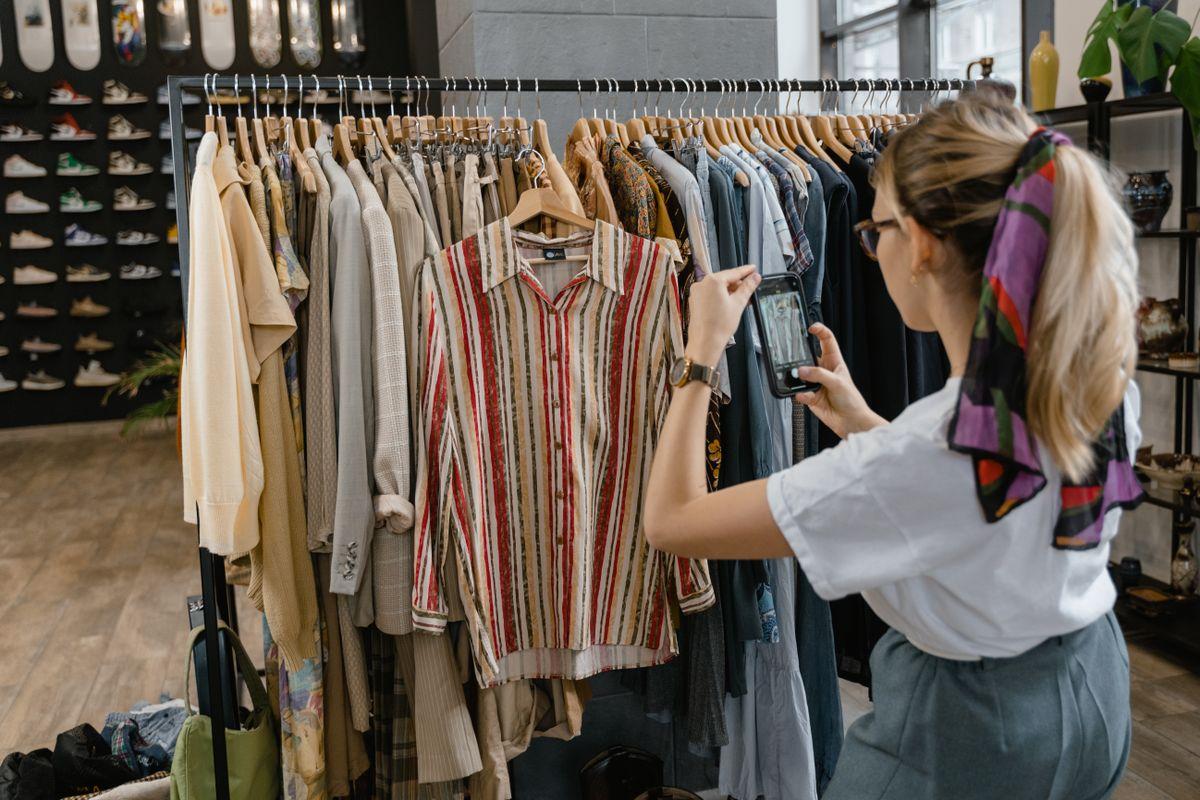
Trend monitoring. AI tools can monitor trending hashtags, audio, and content formats relevant to your niche. Instead of spending an hour scrolling TikTok to figure out what is trending, you get a daily digest of relevant trends with suggestions for how to adapt them to your brand. This is particularly valuable for fashion, where trend windows have collapsed from full seasons to six-week cycles.
Caption writing. Writing good Instagram captions for fashion posts is harder than it looks. You need to describe the piece, communicate the styling suggestion, include a call to action, add relevant hashtags, and sound like yourself — all in under 150 words. AI caption generators handle the structure while you provide the personality. The result is consistent posting without the daily mental tax of figuring out what to say.
Hashtag research. AI hashtag tools analyze which tags are driving engagement for accounts your size in your niche. Instead of copying generic #fashionblogger or #ootd tags (which have millions of posts and zero discovery value), you get niche tags like #slovenianfashion or #slowfashionboutique that actually reach potential customers.
The Weekly Content Routine for a Fashion Boutique
Here is a realistic weekly posting schedule that a one-person boutique can maintain with AI tools:
Monday: New arrivals post (carousel on Instagram, styling Reel, TikTok video). AI writes three caption variations; you pick the best one and customize.
Tuesday: Behind-the-scenes Stories (unboxing, shop update, weather-appropriate styling tip). Quick phone photos, no editing needed.
Wednesday: Customer feature or user-generated content (repost a customer wearing your pieces, tag them, add a short thank-you caption). This builds community and provides social proof.
Thursday: Styling video (one piece, three ways to wear it). Film in the morning, let AI suggest captions and hashtags, post by noon.
Friday: Weekend mood post (lifestyle image or video that captures the feeling of your brand — not a hard sell). Schedule it for Friday evening when people are scrolling.
Saturday: Quick TikTok or Reel if you have time. If not, engage with comments and DMs from the week.
Sunday: Plan next week's content. AI generates a content calendar based on your inventory and upcoming promotions. You review and approve.
This routine takes roughly 4 to 5 hours per week of active work. Without AI tools, the same content output would take 12 to 15 hours. That difference is what makes consistent social media sustainable for a solo boutique owner.
Measuring What Matters
Fashion boutiques often chase vanity metrics — follower count, post likes — when the metrics that actually matter are the ones tied to revenue.
Saves and shares. On Instagram, saves indicate that someone wants to come back to your post later (probably to buy). Shares indicate that your content resonated enough to pass along. Both signal purchase intent. Track these more closely than likes.
Link clicks. Use link-in-bio tools or Instagram Shopping tags to track how many people click through to your product pages. This is your most direct social media-to-sales metric.
DM conversations. For boutiques, DMs are the top of your sales funnel. A customer who DMs asking about sizing is one step from buying. Track how many DMs you receive weekly and how many convert to sales.
Follower growth rate. Not total followers, but the rate of new followers per week. A steady 10 to 20 new followers per week is healthier than 500 one week and zero the next. Consistency signals to the algorithm that your content is worth showing.
Conversion rate from social traffic. If you have an online store, track what percentage of visitors from social media actually purchase. The fashion industry average is 2.45%. If you are below that, the issue is likely either your product pages or the fit between your social content and what you actually sell.
Common Mistakes Fashion Boutiques Make on Social Media
Posting product photos without styling context. A flat-lay photo of a sweater tells nobody anything. Show the sweater on a person, styled with other pieces, in a real setting. Context sells. Product-only shots are catalog filler.
Inconsistent posting. Posting every day for a week, then disappearing for two weeks, tells the algorithm your account is inactive. It takes weeks to recover your reach after a gap. Consistency beats intensity.
Ignoring video. If you are only posting photos, you are invisible to new followers. Instagram's algorithm in 2026 prioritizes Reels for discovery. You do not need professional video equipment — your phone and natural light are enough.
Copying big brand accounts. Zara's Instagram works because it is Zara. Their aesthetic is their own. Copying their style makes your boutique look like a cheap imitation. Find your own visual language and stick with it.
Never engaging with other accounts. Social media is social. If you never comment on other local businesses' posts, never engage with your customers' content, and never participate in your community, the algorithm will not reward you. Spend 15 minutes a day engaging with accounts in your niche.
The Bottom Line for Fashion Boutique Owners
You do not need a marketing degree, a professional photographer, or a social media agency to compete with fast fashion on social media. You need a smartphone, a consistent posting routine, and AI tools that handle the repetitive work so you can focus on curation and customer relationships.
The boutiques that thrive in 2026 are not the ones with the biggest budgets. They are the ones that show up consistently, sound like real people, and make it easy for customers to discover, love, and buy their pieces. AI tools like Picmim handle the scheduling, captions, and trend research. You handle the taste.
Ready to put your boutique's social media on autopilot? Try Picmim free and see how much time AI can give you back to focus on what you do best — curating beautiful clothing and serving your customers.
Sources: Rival IQ (Feb 2026), cufinder.io Fashion Industry Marketing Benchmarks 2026, YouGov (June 2026), TikTok Next 2026 Report, Synup Social Media Statistics 2026, SociaVault Labs Engagement Benchmarks 2026